 11:00 AM
 The Mobile

Performance is only one of many points we consider when we review tablets, but performance affects your overall impression of the tabletâ€"how zippy and responsive it is when you use apps, navigate the operating system, and surf the Web. On top of that, if your tablet's battery fails to deliver long life, you'll find yourself tethered to an outlet more often than you'd like.
Not all of our benchmark tests are available across all operating systems, but we do have a few that run on Apple's iOS, Google's Android, and Microsoft's Windows RT. We put two dozen of the latest tabletsâ€"regardless of screen sizeâ€"to the benchmark test to see how they compare.
We tested all the tablets with the most recent firmware and operating system updates available at the time of testing; such updates can and do affect performance results. When a tablet had more than one Web browser or video player installed, we used the native apps.
 Samsung Galaxy Note 10.1
 Overall, as you'll see in the charts below, we discovered that Nvidia Tegra 3-based Android tablets are among some of the best performers out there, but Samsung's Exynos processorâ€"found in the Google Nexus 10 and the Samsung Galaxy Note 10.1â€"came on strong. As in the past, we also noticed variations in performance stemming from the different processor speeds, system memory, and operating systems in play.
Geekbench
Primate Labs' Geekbench measures single-core CPU, multicore CPU, and memory performance, and works across Android and iOS (we used version 2.3.7 for the former and version 2.3.6 for the latter). On this test, Google's Nexus 10 came out on top: Armed with a Samsung Exynos 5 Dual processor (based on the dual-core ARM Cortex-A15), the Nexus 10 was the runaway leader, earning a score of 2354 on Geekbenchâ€"a difference of 29 percent over the next-closest competitor, the 1.4GHz Exynos quad-core-based Samsung Galaxy Note 10.1. The Nexus 10 boasted better single-core and memory performance in comparison with the Nvidia Tegra 3 quad-core tablets, and that was reflected in the Google tablet's stellar results.
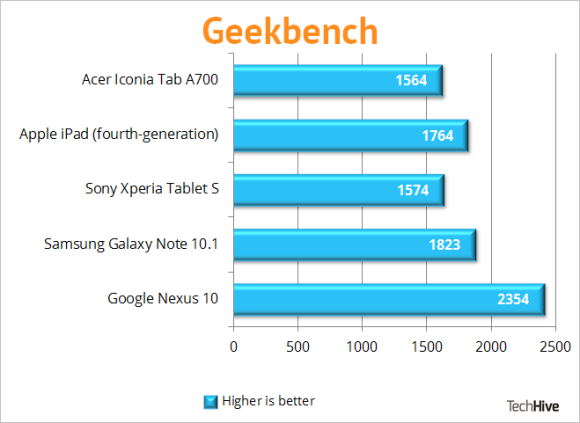
Beyond our top five performersâ€"all of them 9- or 10-inch-class tabletsâ€"shown above, two other Nvidia Tegra 3-based tablets came close to making the cut: Fujitsu's Stylistic M532 posted a mark of 1555, and Toshiba's Excite 10 reached a score of 1513. Oddly, the Asus Transformer Pad Infinity TF700, a previous top-flying performer, had a score of just 1384. In general, however, Tegra 3 tablets do better than the Nexus 10's Exynos 5 on multicore tests, according to Geekbench results.
Another trend: None of the 7-inch models we tested made the top five. Among the 7-inch models we evaluated, the Tegra 3-based Toshiba Excite 7.7 achieved a mark of 1488, followed by the Google Nexus 7 at 1404. The Apple iPad mini managed a score of just 756.
AndEbench
Available for Android only, EEMBC's AndEBench tests multicore CPU and Java performance. Here, we saw a flip in some results as compared with Geekbench, while other tablets performed consistently between the two tests.

On the Native AndEBench test, the Asus Transformer Pad Infinity TF700 soared to the top, followed by the Samsung Galaxy Note 10.1, Fujitsu Stylistic M532, Sony Xperia Tablet S, and Acer Iconia Tab A700. All of these tablets have quad-core processors, and all but the Galaxy Note 10.1 use Nvidia's Tegra 3 system-on-chip platform.
The Google Nexus 10 posted a score of just 6306 on this test, below the average. Of the 7-inch tablets, the Tegra 3-based Toshiba Excite 7.7 led with a mark of 8394, followed by Google's Nexus 7 at 8113. The Amazon Kindle Fire HD, which uses Texas Instruments' OMAP4460, reached a score of 4311, well below the average.
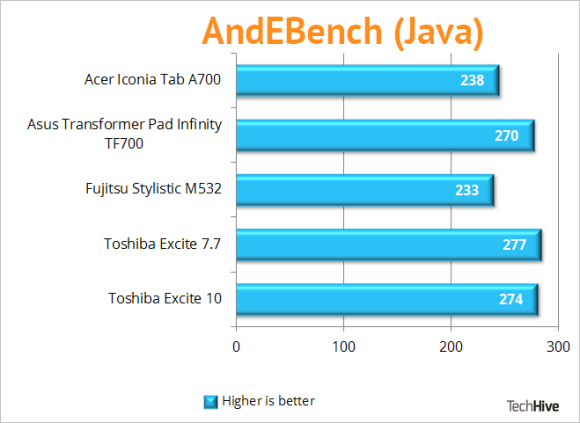
On the Java test, Toshiba's two Excite tablets topped the chart, followed closely by the Asus Transformer Pad Infinity. Acer and Fujitsu's steady performers rounded out the top five slots. Google's Nexus 7 achieved a mark of 216, Sony's Xperia Tablet S had a score of 212, and Samsung's Galaxy Note 10.1 managed a score of 190. Amazon's Kindle Fire HD again underperformed, reaching just 165 on this test.


0 comments:
Post a Comment